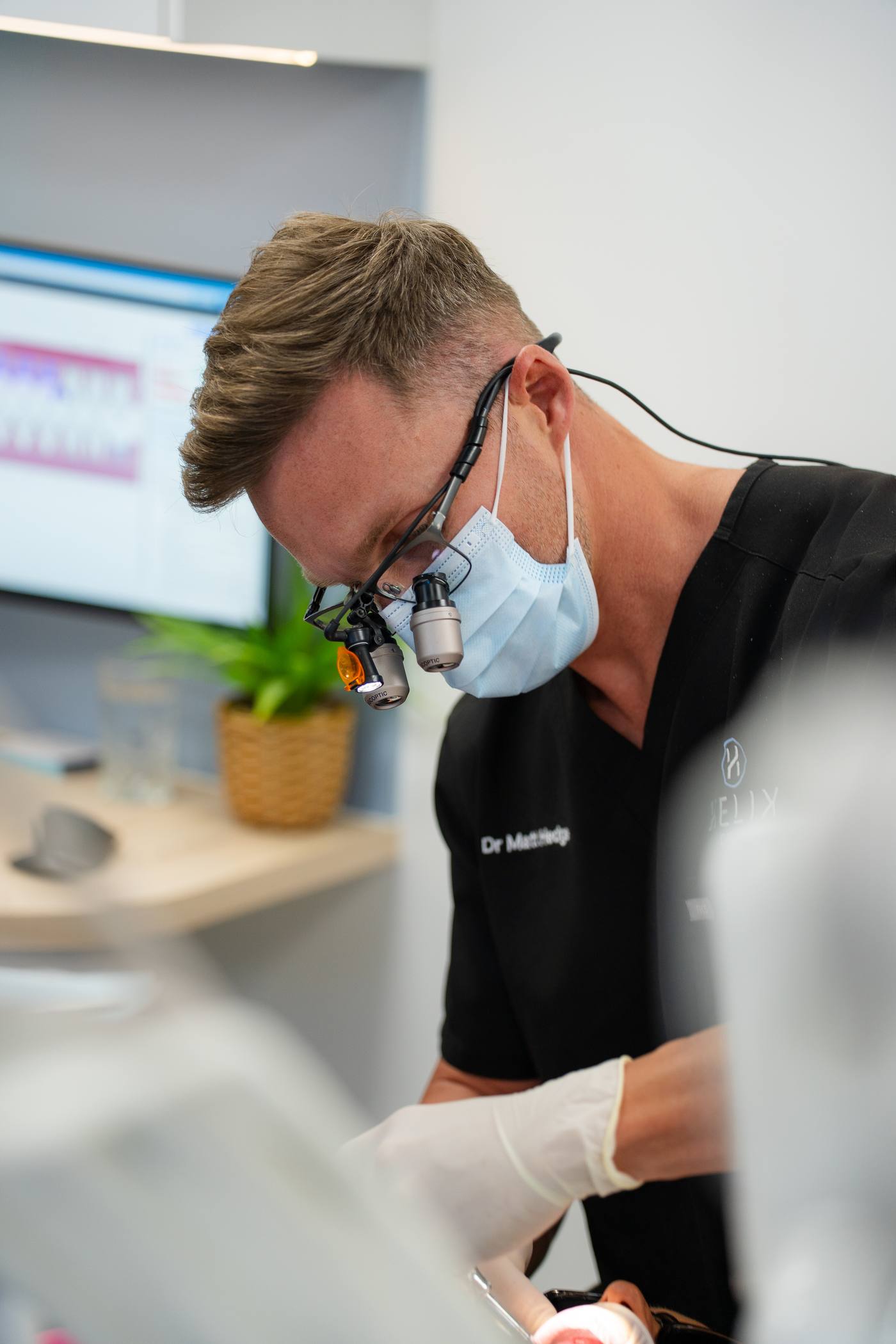
Removable trays that move teeth gradually, without fixed brackets or wires. We provide two systems and will tell you honestly if neither suits your case.
Clear aligners are a series of removable trays, each worn for a set period before moving to the next. Every tray is slightly different from the one before, so the teeth move in small increments across the course of treatment. There are no fixed brackets and no wires, and the trays come out for eating and cleaning.
They are not a single product. Several manufacturers make them, the systems differ in how they are planned and made, and the right one depends on what your teeth need to do rather than on brand preference.
Invisalign is the longest-established system and has the widest range of attachments and refinement options, which makes it the usual choice for more complex movement. There is a full explanation of how it works, what treatment involves and what it costs on our Invisalign page.
Angel Aligners is a newer system that can be a sensible option for more straightforward cases. It is generally less expensive than Invisalign for comparable treatment.
We will recommend one over the other based on the movement your case needs, not on what is quickest to fit. Where neither is appropriate, we will say so.
Aligners move teeth well within a certain range. Outside it, fixed braces do a better and often faster job, and some cases are better referred to a specialist orthodontist. Cases that commonly fall outside that range include significant bite discrepancies, teeth that need substantial rotation, and situations where a tooth must be moved bodily rather than tipped.
Active decay or gum disease has to be treated before any orthodontic treatment begins. Moving teeth through unhealthy tissue makes the underlying problem worse.
Treatment begins with an examination and a digital scan. From there a treatment plan is prepared, showing the intended sequence of movement. A plan is a projection rather than a promise, and cases are commonly refined partway through with additional trays.
Trays are typically worn 20 to 22 hours a day. Wear time is the single biggest factor in whether treatment tracks to plan, and it is entirely in the patient's hands. Retainers are needed afterwards, indefinitely, because teeth drift back towards their previous positions without them.
Clear aligner treatment in Australia generally runs between $5,000 and $7,500, and the range is wide because cases differ substantially in how much movement is required and how long treatment takes. Angel Aligners generally sits at the lower end of that range and Invisalign towards the upper.
A written quote is prepared after a clinical assessment. Payment plans are available, terms apply.
All orthodontic treatment carries risk. Discomfort and pressure are normal in the first days of each new tray. Speech can be affected briefly. Other risks include root resorption, where root length shortens during movement; gum recession; decalcification or decay if oral hygiene slips during treatment; a small and permanent amount of enamel reduction between teeth where the plan calls for it; the need for refinement trays or a change of approach; and relapse, where teeth drift back if retainers are not worn.
Results vary between individuals and no orthodontic outcome can be guaranteed. Your dentist will go through the risks that apply to your case, and the alternatives, before you decide.
General information only. This page provides general information about dental treatment and is not a substitute for individual clinical advice. Whether any treatment is suitable for you can only be determined by a dentist after an examination. Results and recovery vary from person to person and are not guaranteed.
Any surgical or invasive procedure carries risks. Before proceeding, you should seek a second opinion from an appropriately qualified health practitioner.
Good to know
Both are clear removable tray systems. Invisalign is longer established with a wider range of attachments and refinement options, which suits more complex movement. Angel Aligners is newer and generally less expensive, and can be appropriate for more straightforward cases. Which one we recommend depends on the movement your case requires.
Treatment in Australia generally runs between $5,000 and $7,500 depending on how much movement is needed and how long treatment takes. A written quote is prepared after a clinical assessment. Payment plans are available, terms apply.
It depends entirely on the case, and on how consistently the trays are worn. Trays are typically worn 20 to 22 hours a day, and wear time is the biggest single factor in whether treatment tracks to the plan.
Yes, indefinitely. Teeth drift back towards their previous positions without retention, and relapse is one of the more common reasons people are unhappy with an orthodontic result later on.
No. Aligners move teeth well within a certain range. Significant bite discrepancies, substantial rotation and cases needing bodily movement are often better treated with fixed braces or referred to a specialist orthodontist. We will tell you if that applies to you.
An assessment tells you whether aligners can move your teeth the way they need to move. Call 07 5572 8969 or book online.
Book a Consult